


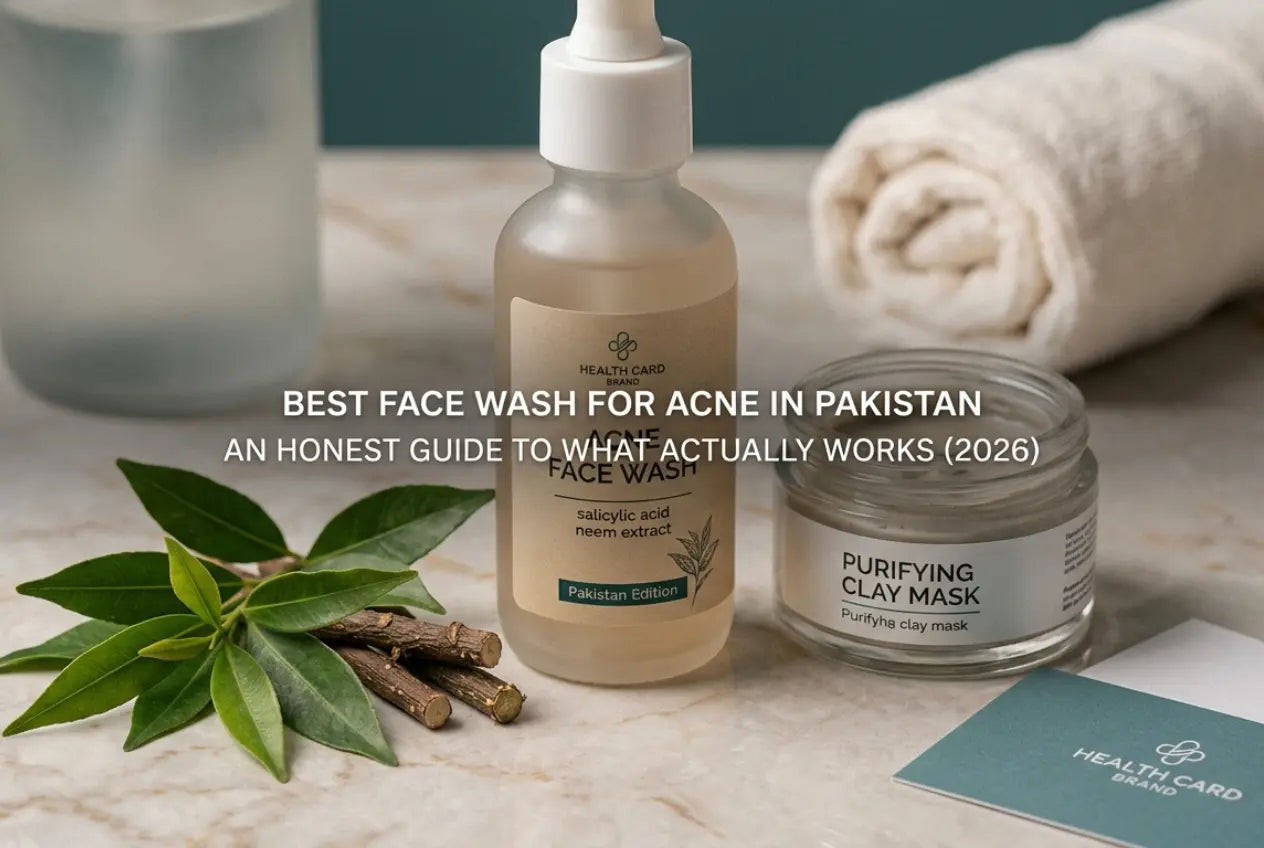
The short answer: the best face wash for acne is a gentle, non-stripping cleanser built around a proven antibacterial or pore-clearing ingredient such as neem, tea tree oil, activated charcoal, or salicylic acid, used twice a day with lukewarm water. In Pakistan's heat, humidity, and dust, the wrong face wash does not just fail to help. It actively makes breakouts worse. This guide explains how to pick the right one for your skin, how to use it properly, and what no product label will tell you.
If you have already tried three or four anti acne face washes and your skin still breaks out, you are not imagining things, and it is probably not your fault. Most people in Pakistan choose acne cleansers based on packaging claims rather than ingredients, skin type, or climate. Let's fix that.
(Image 1: person washing face with foaming herbal cleanser. Alt text: Woman washing acne prone skin with herbal anti acne face wash in Pakistan)
Why Acne Is So Stubborn in Pakistan
Acne develops when pores get blocked by a mix of dead skin cells and sebum, which is your skin's natural oil. The bacteria trapped inside then trigger inflammation. That is the biology. But three local factors make things harder here than in most countries.
Heat and humidity keep your oil glands in overdrive. From April to September, cities like Karachi, Lahore, and Rawalpindi sit in the exact temperature and humidity range where sebum production peaks. More oil means more clogged pores, which is why so many people notice their acne is worst in summer and during monsoon season.
Dust and pollution settle into your pores. Traffic exhaust and airborne dust particles are small enough to lodge in pores and mix with sebum, forming the blackheads and congestion that turn into pimples. If you commute by bike or spend time outdoors, your face collects a visible film of grime by evening, and sleeping with it on is one of the fastest routes to a breakout.
Hard water quietly irritates your skin. Large parts of Punjab and Sindh have hard tap water that is rich in calcium and magnesium. Hard water prevents cleansers from rinsing off completely, leaving a residue that disturbs the skin barrier and can trigger irritation based breakouts. If your face feels tight and squeaky after washing, hard water plus a harsh cleanser is often the reason.
Understanding this matters because it changes what "best" means. In this climate, you do not need the strongest face wash. You need one that removes oil, dust, and bacteria effectively without stripping the skin so badly that it produces even more oil in response.
What a Face Wash Can and Cannot Do for Acne
Here is the honest part most brands skip.
A face wash stays on your skin for about sixty seconds and then goes down the drain. In that minute, a good one can remove excess sebum, dust, sweat, sunscreen, and surface bacteria. It can keep pores from clogging further, calm surface inflammation with the right botanical ingredients, and prep your skin so serums and creams absorb better.
What it cannot do is cure hormonal acne, erase deep cystic pimples, or remove acne scars. No cleanser can, regardless of price. A face wash is your foundation. It prevents new breakouts and supports everything else in your routine. For mild to moderate acne, the right cleanser plus a targeted treatment genuinely changes skin within weeks. For severe, painful, cystic acne, you need a dermatologist, and we will cover that below.
Any brand promising an acne cure in days from a face wash alone is telling you what you want to hear, not the truth.
Acne Fighting Ingredients That Actually Work
(Image 2: flat lay of neem leaves, tea tree oil, charcoal, and aloe. Alt text: Natural acne fighting ingredients neem leaves tea tree oil and activated charcoal for face wash)
Ignore the front of the bottle and read the ingredients instead. These are the ones with real evidence behind them.
Neem. Naturally antibacterial and anti inflammatory. It targets acne causing bacteria and calms redness without harsh drying. Best for active pimples and for oily or sensitive skin.
Tea tree oil. A well studied antimicrobial. Research shows it reduces acne lesions comparably to mild benzoyl peroxide, with less irritation. Best for inflamed breakouts and sensitive skin.
Activated charcoal. Its porous structure binds and lifts oil, dust, and pollution out of pores. Best for very oily skin, blackheads, and anyone who spends hours in traffic or outdoors.
Salicylic acid. An oil soluble acid that exfoliates inside the pore lining to dissolve clogs. Best for blackheads, whiteheads, and rough, textured skin.
Niacinamide. Strengthens the skin barrier, regulates oil, and fades post acne marks over time. Best for redness, dark spots, and combination skin.
Aloe vera. Soothes and hydrates, and offsets the drying effect of stronger ingredients. Good for any acne prone skin that also feels tight after washing.
Ingredients to avoid in an acne face wash: harsh sulfates in high concentrations, alcohol heavy formulas, rough physical beads used daily, and heavy fragrance. Every one of them damages the skin barrier, and a damaged barrier breaks out more, not less.
Herbal or Medicated: Which Type Should You Choose?
This is the question most guides never answer honestly, because most of them only sell one type.
Choose a herbal face wash with neem, tea tree, or charcoal if your acne is mild to moderate, your skin is sensitive or easily irritated, you have reacted badly to acids before, you are a teenager just starting skincare, or you want something gentle enough for daily, long term use. Herbal antibacterials like neem work more gradually but with far less risk of the dryness, irritation, and rebound oil cycle.
Choose a medicated face wash with salicylic acid or benzoyl peroxide if your acne is moderate to persistent, your skin is resilient and very oily, and you are prepared to introduce actives slowly and moisturize diligently. These work faster on stubborn congestion but punish careless use.
The practical middle path that many dermatology minded routines follow: use a gentle herbal antibacterial cleanser twice daily as your base, and add a leave on treatment such as a serum or spot cream for targeted action. Leave on products stay on the skin for hours, so that is where stronger actives earn their keep, not in a wash you rinse off in a minute.
Our Pick: The Face Washes We Would Actually Recommend
(Image 3: Herbsalot Anti-Acne Neem Face Wash product shot. Alt text: Herbsalot Anti Acne Neem Face Wash best herbal face wash for acne in Pakistan)
For most acne prone skin in Pakistan, a neem based cleanser is the smartest starting point, and that is why the Anti-Acne Neem Face Wash is the one we recommend first. Neem gives you genuine antibacterial action against breakout causing bacteria, but in a formula gentle enough to use morning and night through Pakistani summers without wrecking your skin barrier. It suits oily, combination, and sensitive acne prone skin alike, which makes it a safe first choice when you are not sure what your skin tolerates.
If your skin runs very oily, the kind that is shiny again by noon, or your main battle is blackheads and city grime, the Activated Charcoal Face Wash is the better fit. Charcoal physically draws oil and pollution out of pores, which makes it especially effective as an evening cleanser after a day outdoors.
A simple rule of thumb: neem for pimples and sensitivity, charcoal for oil and blackheads. Some people with very oily, breakout prone skin use charcoal at night and neem in the morning, a combination that covers both problems without over stripping.
How to Wash Your Face When You Have Acne (Most People Do This Wrong)
The technique matters nearly as much as the product.
-
Use lukewarm water, never hot. Hot water strips the barrier and worsens redness, while cold water does not dissolve oil well.
-
Wash for a full 60 seconds. Most people rub for five seconds and rinse. Active ingredients need contact time to work. Massage gently in circles and spend extra time on the forehead, nose, and chin.
-
Use your fingertips only. No loofahs, brushes, or rough cloths on active acne. Friction inflames pimples and spreads bacteria.
-
Rinse thoroughly. Leftover cleanser residue, especially with hard water, causes irritation along the hairline and jaw.
-
Pat dry with a clean towel. Rubbing irritates the skin, and a damp or reused towel reintroduces bacteria. Change your face towel every two to three days.
-
Wash twice a day, plus after heavy sweating. Morning, night, and after sports or a sweaty commute. That is it.
The over washing trap: in our heat, it is tempting to wash four or five times a day. Do not. Over washing strips the skin, the skin panics and produces more oil, and you break out worse than before. If your face feels greasy midday, blot with a tissue or rinse with plain water instead of using cleanser again.
A Face Wash Alone Will Not Clear Your Skin, So Build the Full Routine
(Image 4: simple four step routine graphic. Alt text: Four step anti acne skincare routine with face wash serum moisturizer and scrub)
Cleansing is step one of a system, not the whole system. Here is the minimal routine that actually moves the needle for acne prone skin.
Step 1: Cleanse, morning and night. Your neem or charcoal face wash, exactly as described above.
Step 2: Treat, at night. A leave on treatment does the heavy lifting overnight. A targeted option like the Neem and Tea Tree Acne Serum combines two proven antibacterial botanicals and stays on the skin for hours, which is exactly where treatment ingredients belong.
Step 3: Moisturize, morning and night. Yes, even oily skin. Skipping moisturizer triggers rebound oil production. A light option such as the Neem Anti-Acne Cream hydrates while keeping the antibacterial theme consistent, instead of undoing your cleanser's work with a heavy, pore clogging cream.
Step 4: Exfoliate, twice a week, at night only. Dead skin cells are half of every clogged pore. A gentle scrub like the Anti-Acne Neem Blackhead Scrub used twice weekly keeps pores clear. Never scrub over inflamed, active pimples, and never scrub daily.
If you would rather not assemble the pieces yourself, the Anti-Acne Neem Bundle packages the routine together, which makes it a practical starting point for anyone building an acne routine from zero.
Five Mistakes That Keep Your Acne Coming Back
-
Changing face washes every two weeks. Skin needs four to eight weeks to show real results. Constant switching resets the clock and irritates your skin in the process.
-
Touching and popping. Your hands transfer bacteria, and popping pushes inflammation deeper and creates the dark marks that outlast the pimple by months.
-
Dirty pillowcases and phone screens. Both press oil and bacteria against your face for hours. Change pillowcases weekly and wipe your phone daily.
-
Skipping sunscreen. Sun exposure darkens post acne marks dramatically. If dark spots bother you more than the pimples themselves, sun protection is non negotiable.
-
Treating fungal acne like bacterial acne. If you have uniform, itchy small bumps on your forehead or hairline that never respond to any acne product, it may be fungal acne, which is a different problem needing different treatment. This is a common reason why "nothing works."
When a Face Wash Is Not Enough: See a Dermatologist
Skincare has limits, and pretending otherwise costs people years of scarring. See a dermatologist if you have deep, painful cysts or nodules, acne that leaves pitted scars, breakouts that have not improved after two to three months of consistent care, or acne accompanied by irregular periods or sudden hormonal changes. The American Academy of Dermatology notes that acne is the most common skin condition and that effective medical treatments exist for every severity. Early treatment is also the best prevention against permanent scarring. There is no shame in prescription help. A good face wash then becomes the supporting act to medical treatment, not its replacement.
Frequently Asked Questions
Which face wash is best for acne in Pakistan?
For most people, a gentle antibacterial cleanser built on neem or tea tree oil is the best starting point. It fights breakout causing bacteria yet stays mild enough for twice daily use in hot weather. Very oily skin with blackheads often does better with an activated charcoal face wash. Match the ingredient to your skin type rather than chasing brand names.
Which face wash is best for pimples and oily skin in Pakistan?
Charcoal and neem based cleansers are both excellent for oily, pimple prone skin. Charcoal absorbs excess oil and pulls pollution out of pores, while neem targets the bacteria that turn clogged pores into pimples. Avoid harsh formulas that leave skin squeaky and tight, because stripping oily skin only makes it produce more oil.
Can I use an acne face wash every day?
Yes. Twice daily, morning and night, is the ideal frequency, plus once after heavy sweating. More than that backfires. Over washing strips the skin barrier, triggers rebound oil production, and worsens breakouts. If your face feels oily midday, blot with a tissue instead of washing again.
Does neem face wash really remove pimples?
Yes, for mild to moderate acne. Neem contains naturally antibacterial and anti inflammatory compounds that reduce the bacteria and redness behind pimples. It works more gradually than strong acids but with far less dryness and irritation, which makes it well suited to sensitive and teenage skin. Expect visible improvement over three to six weeks of consistent use.
How long does an acne face wash take to show results?
Give any face wash four to eight weeks of consistent twice daily use before judging it. Skin renews itself in roughly 28 day cycles, so pimples already forming under the surface will still appear in the first couple of weeks. Oil control and fewer new breakouts usually show first, and fading of dark marks takes longer.
Can a face wash remove acne scars and dark spots?
No face wash can remove true acne scars, and anyone claiming otherwise is overselling. Cleansers with brightening ingredients can help fade dark marks gradually, but indented scars need professional treatments. The best strategy is prevention: treat acne early, never pop pimples, and wear sunscreen so marks do not darken further.
Conclusion
The best face wash for acne in Pakistan is not the harshest one or the most expensive one. It is the gentle, ingredient smart cleanser you will actually use twice a day, every day, through summer humidity and winter dryness alike. Start with neem if your skin is sensitive or breakout prone, choose charcoal if it is very oily, wash for a full minute with lukewarm water, back it up with a treatment serum and a light moisturizer, and give the routine six honest weeks. Your skin does not need twenty products. It needs the right four, used consistently.


