


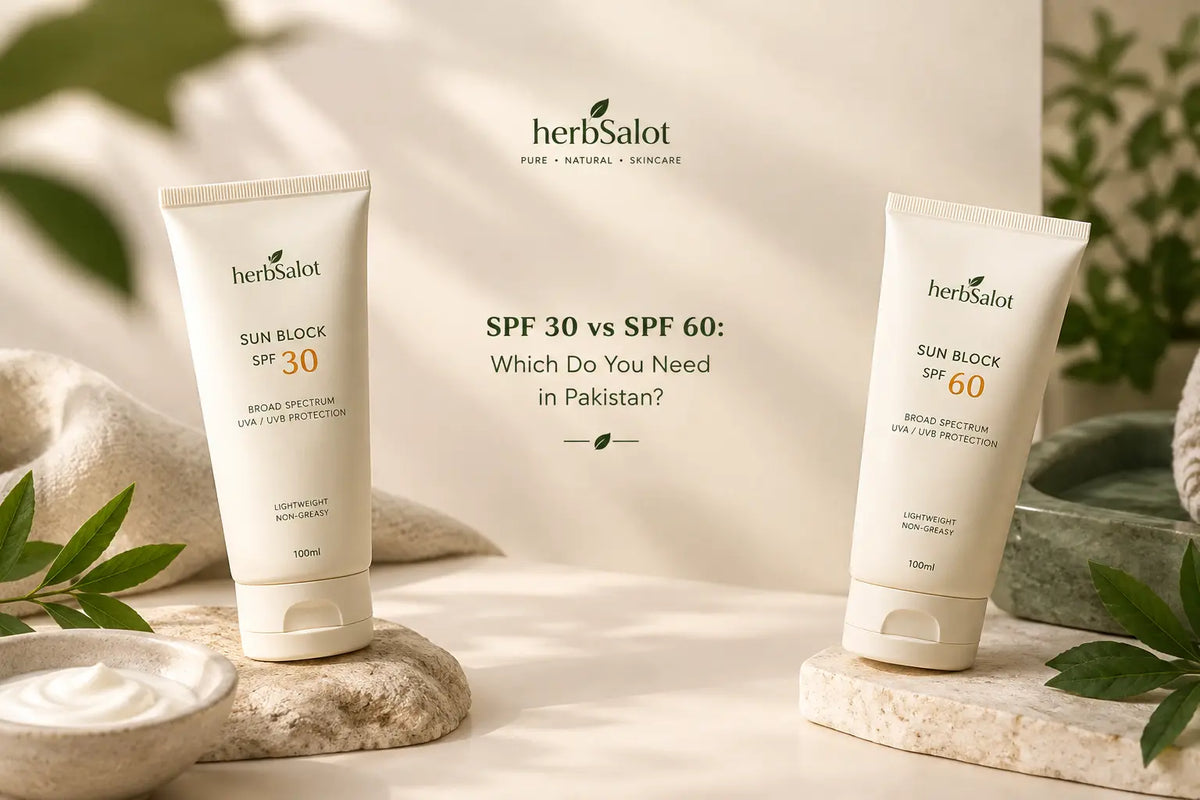
You are standing in front of the sunscreen shelf, and the numbers are staring back at you. SPF 30, SPF 50, SPF 60. Bigger number, better protection, right? So should you just grab the highest one? Not necessarily. In Pakistan's strong sun, choosing between SPF 30 and SPF 60 is less about the number and more about how you live and how you apply it.
Quick answer: For most daily use in Pakistan, a broad-spectrum SPF 30 is enough, blocking about 97% of UVB rays. SPF 60 blocks slightly more, around 98%, and suits long hours in direct sun, outdoor jobs, and extended exposure. The bigger factor is applying enough sunscreen and reapplying every few hours, which matters far more than the number itself.
This guide explains what SPF really means, the real difference between SPF 30 and 60, which one fits your daily life in Pakistan, and how to use either one properly.
What Does SPF Actually Mean?
SPF, or Sun Protection Factor, measures how well a sunscreen protects your skin from UVB rays, the ones that cause sunburn and contribute to skin damage and tanning. A higher SPF blocks slightly more UVB, but the increase is smaller than most people expect.
Here is the part that surprises everyone. SPF is not a linear scale, so SPF 60 is not twice as protective as SPF 30. The numbers describe how much UVB is blocked: SPF 30 blocks about 97%, SPF 50 about 98%, and SPF 60 about 98%. The jump from 30 to 60 adds only a small percentage of extra protection. This is why dermatologists say the number matters far less than applying enough sunscreen and reapplying it, which is where most people actually fall short.
What Is the Real Difference Between SPF 30 and SPF 60?
The real difference between SPF 30 and SPF 60 is small in terms of UVB blocked, roughly 97% versus 98%. SPF 60 offers a slightly higher margin of protection, which becomes useful during long, direct sun exposure, but for everyday use the difference is minor.
|
Feature |
SPF 30 |
SPF 60 |
|
UVB blocked |
About 97% |
About 98% |
|
Best for |
Daily use, commutes, indoors |
Long outdoor exposure, strong sun |
|
Reapplication needed |
Yes, every 2 to 3 hours |
Yes, every 2 to 3 hours |
|
Practical difference |
Excellent everyday protection |
Slightly higher safety margin |
The takeaway: neither number lets you skip reapplication, and both need a proper amount applied. SPF 60's edge is a bigger buffer for when you cannot reapply easily or when you are out in harsh sun for hours. A flexible sunblock offering a range like SPF 30 to 60 covers both situations, which is convenient for Pakistan's varied days.
Which SPF Do You Need for Your Daily Life in Pakistan?
For most people in Pakistan, SPF 30 is enough for indoor days and short commutes, while SPF 60 is better for outdoor workers, long travel, and extended time in direct sun. Match the SPF to your actual sun exposure.
|
Your typical day |
Recommended SPF |
|
Mostly indoors, short commute |
SPF 30, broad-spectrum |
|
Office worker with some outdoor time |
SPF 30 to 50 |
|
University student, daily travel in the sun |
SPF 50 to 60 |
|
Outdoor job, field work, long commutes |
SPF 60 |
|
Bikers and long sun exposure |
SPF 60, reapplied often |
|
Beach, hiking, weddings outdoors |
SPF 60, reapplied often |
Pakistan's sun is strong for most of the year, so even indoor days deserve SPF 30, since UV passes through windows. But if your routine involves real time outdoors, whether commuting on a bike, studying across campus, or working in the field, the higher SPF 60 gives you a more comfortable safety margin, especially when reapplying every few hours is not practical.
Does a Higher SPF Mean You Can Skip Reapplication?
No. A higher SPF does not last longer or remove the need to reapply. All sunscreens, including SPF 60, wear off through sweat, rubbing and time, so both SPF 30 and SPF 60 must be reapplied every two to three hours during sun exposure.
This is the most common and costly sunscreen myth. People buy SPF 60 believing it means all-day protection from one application. It does not. SPF measures the strength of protection, not how long it lasts. Sweat in Pakistan's heat, wiping your face, and simple time all break sunscreen down. So whether you choose SPF 30 or 60, reapplication every two to three hours during outdoor exposure is what actually keeps you protected. An SPF 60 applied once in the morning offers less real protection by afternoon than an SPF 30 reapplied properly.
What Matters More Than the SPF Number?
What matters more than the SPF number is choosing a broad-spectrum sunscreen, applying enough of it, reapplying regularly, and using it every single day. These habits protect your skin far more than jumping from SPF 30 to SPF 60.
Focus on these first:
-
Broad-spectrum protection. It must protect against both UVA (ageing, dark spots) and UVB (burning). This matters more than the SPF number.
-
Applying enough. Most people use far too little. Use a generous, even layer on the face, neck and ears.
-
Reapplying. Every two to three hours during outdoor exposure, whatever the SPF.
-
Daily use. Sunscreen only works if you actually wear it every day, including cloudy days and indoors.
-
The right formula for your skin. For oily skin, a lightweight, non-greasy, matte formula makes daily use easy.
A broad-spectrum sunblock covering SPF 30 to 60, like the Super Advanced Sun Block SPF 30-60, gives you flexibility for both everyday and heavy-exposure days, made for Pakistan's climate.
SPF 30 vs SPF 60: Quick Recap
-
SPF 30 blocks about 97% of UVB; SPF 60 blocks about 98%. The difference is small.
-
SPF 30 suits daily indoor and short-commute use; SPF 60 suits long outdoor exposure.
-
A higher SPF does not last longer, so both need reapplying every two to three hours.
-
Applying enough, reapplying, and daily use matter far more than the number.
-
Always choose broad-spectrum protection against both UVA and UVB.
-
A flexible SPF 30 to 60 sunblock covers both everyday and heavy-sun days.
Ready to protect your skin properly in Pakistan's sun? Explore the Super Advanced Sun Block SPF 30-60 for broad-spectrum daily protection, with delivery across Pakistan.
Frequently Asked Questions
Is SPF 60 better than SPF 30?
SPF 60 blocks slightly more UVB, about 98% versus 97% for SPF 30, so the difference is small. SPF 60 offers a bigger safety margin for long sun exposure, but SPF 30 is enough for most daily use when applied properly and reapplied.
Which SPF is best for Pakistan's sun?
For daily indoor use and short commutes, SPF 30 is enough. For long outdoor exposure, field work, biking or travel in strong sun, SPF 60 is better. Pakistan's strong sun means daily sunscreen matters regardless of the number.
Does a higher SPF last longer?
No. SPF measures the strength of protection, not how long it lasts. All sunscreens wear off with sweat and time, so both SPF 30 and SPF 60 must be reapplied every two to three hours during sun exposure.
Do I need SPF 60 if I stay indoors?
Usually not. SPF 30 is enough for indoor days, though you should still wear it, since UV rays pass through windows. Save SPF 60 for days with significant outdoor exposure.
Is SPF 30 enough for daily use in Pakistan?
Yes, broad-spectrum SPF 30 is enough for everyday use, blocking about 97% of UVB. The key is applying a generous layer, reapplying every few hours outdoors, and using it every day.
What is more important than the SPF number?
Choosing broad-spectrum protection, applying enough sunscreen, reapplying regularly, and wearing it daily matter far more than the SPF number. These habits protect your skin more than moving from SPF 30 to SPF 60.


