


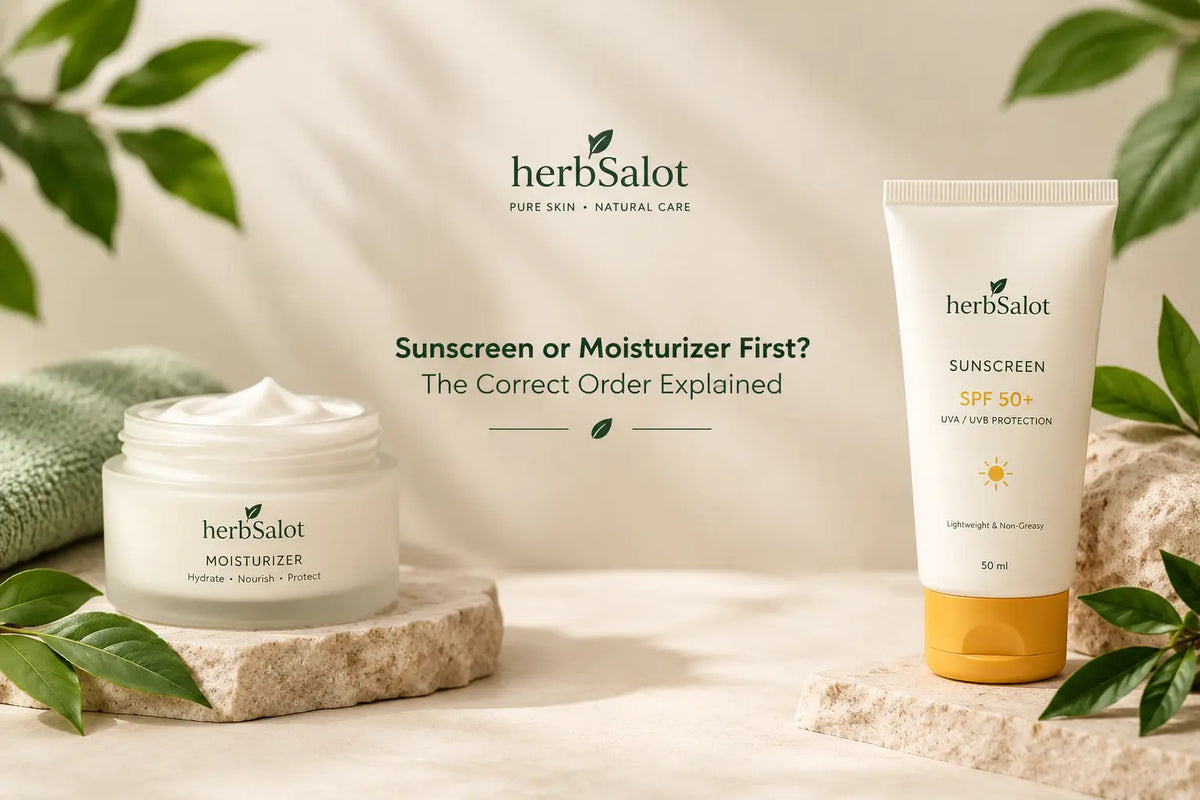
You are halfway through your morning routine, moisturizer in one hand, sunscreen in the other, and you pause. Which one goes first? It seems like a tiny detail, but get it wrong and your sunscreen cannot protect you properly. The good news is that the rule is simple and easy to remember.
Apply moisturizer first, then sunscreen. Moisturizer hydrates and preps your skin, and sunscreen goes on top as the final step so it can form an even protective layer against UV rays. Wait one to two minutes for the moisturizer to absorb before applying sunscreen, and always apply sunscreen last in your morning routine.
This guide explains why moisturizer comes first, how long to wait between them, where sunscreen fits in your full routine, and the common mistakes that weaken your sun protection.
Do You Apply Sunscreen or Moisturizer First?
You apply moisturizer first and sunscreen second. Moisturizer hydrates and prepares the skin, while sunscreen needs to sit on top as the outermost layer to form an even, effective shield against UV rays. Applying it last keeps it working as intended.
The logic follows the basic skincare rule of thinnest to thickest, and then protection last. Moisturizer sinks into the skin to hydrate it, so it belongs underneath. Sunscreen works on the surface, creating a protective film that blocks and filters UV rays. If you put sunscreen on first and then rub moisturizer over it, you break up that protective film and dilute it, which reduces how well it shields your skin. So the order is simple: hydrate first, protect last.
Why Does Moisturizer Go Before Sunscreen?
Moisturizer goes before sunscreen because it needs to absorb into the skin to hydrate it, while sunscreen must stay on the surface to protect it. Layering moisturizer under sunscreen lets each product do its job without interfering with the other.
Here is what happens when you get the order right. Your moisturizer absorbs and hydrates, leaving a smooth, prepped base. Your sunscreen then spreads evenly on top and forms an unbroken protective layer. Each product works fully. When you reverse the order, the moisturizer disturbs the sunscreen film that was supposed to stay intact on the surface, so your protection becomes patchy and weaker. This matters a lot in Pakistan’s strong sun, where even small gaps in protection lead to tanning and dark spots.
How Long Should You Wait Between Moisturizer and Sunscreen?
Wait about one to two minutes between moisturizer and sunscreen, letting the moisturizer absorb first. Applying sunscreen onto skin that is still wet or tacky can make it patchy and less effective, so give the moisturizer a moment to settle.
You do not need to wait long. Apply your moisturizer, let it sink in for a minute or two until your skin feels settled rather than wet, then apply an even layer of sunscreen. This short pause helps the sunscreen spread smoothly and form the even film it needs to protect you. The same applies if you use a serum underneath: serum first, then moisturizer, then a brief wait, then sunscreen.
Where Does Sunscreen Fit in Your Full Morning Routine?
Sunscreen is always the final step of your morning skincare routine, applied after cleanser, any serum, and moisturizer. The correct order is cleanse, treat, moisturize, then protect with sunscreen last.
Here is the full morning sequence:
-
Cleanse. Wash with a face wash suited to your skin type.
-
Treat. Apply any serum, such as a brightening or hydrating one.
-
Moisturize. Apply a light moisturizer and let it absorb.
-
Protect. Apply sunscreen last, as the outermost layer.
Sunscreen always comes last because it is your shield, and a shield works only on the outside. A broad-spectrum option like the Super Advanced Sun Block sits comfortably over moisturizer and protects against tanning, dark spots and sun damage.
Can You Use a Moisturizer With SPF Instead?
You can use a moisturizer with SPF for light, everyday indoor use, but a dedicated sunscreen gives stronger, more reliable protection. For real sun exposure in Pakistan, apply moisturizer and a separate sunscreen rather than relying on an SPF moisturizer alone.
Moisturizers with built-in SPF are convenient, but people usually apply too little to get the labelled protection, and the SPF is often lower than a dedicated sunscreen. For quick indoor days they are fine, but for commuting, outdoor time or Pakistan’s strong sun, a separate sunscreen applied as the final step protects you far better. Think of an SPF moisturizer as a backup, not a replacement.
What Mistakes Weaken Your Sun Protection?
The main mistakes are applying sunscreen before moisturizer, using too little sunscreen, skipping reapplication, mixing sunscreen with other products, and skipping it indoors. Each one reduces how well your skin is protected.
Avoid these errors:
-
Applying sunscreen first, then moisturizer. This breaks the protective layer.
-
Using too little sunscreen. Apply a generous, even layer to the face, neck and ears.
-
Skipping reapplication. Reapply every two to three hours during outdoor exposure.
-
Mixing sunscreen into moisturizer in your hand. This dilutes it. Apply them as separate layers.
-
Skipping sunscreen indoors. UV rays pass through windows, so apply it daily.
Quick Recap
-
Apply moisturizer first, then sunscreen last.
-
Moisturizer absorbs to hydrate; sunscreen stays on top to protect.
-
Wait one to two minutes between them so the sunscreen applies evenly.
-
The full morning order is cleanse, treat, moisturize, protect.
-
A dedicated sunscreen protects better than an SPF moisturizer alone.
-
Apply enough, reapply outdoors, and never skip it, even indoors.
Ready to protect your skin the right way? Finish your routine with the Super Advanced Sun Block, with delivery across Pakistan.
Frequently Asked Questions
Do you apply sunscreen or moisturizer first?
Apply moisturizer first, then sunscreen. Moisturizer hydrates and preps the skin, while sunscreen goes on top as the final step to form an even protective layer against UV rays. Applying sunscreen last keeps it working properly.
How long should I wait between moisturizer and sunscreen?
Wait about one to two minutes, letting the moisturizer absorb until your skin feels settled rather than wet. Applying sunscreen onto tacky skin can make it patchy and less effective.
Does sunscreen go on before or after moisturizer in a routine?
Sunscreen goes after moisturizer and is always the last step of your morning routine. The correct order is cleanse, treat, moisturize, then protect with sunscreen.
Can I skip moisturizer and just use sunscreen?
If your skin is well hydrated you can, but most skin benefits from moisturizer first, especially dry skin. Many sunscreens are not very hydrating, so moisturizer underneath keeps skin comfortable.
Is a moisturizer with SPF enough on its own?
For light indoor days it can be, but a dedicated sunscreen gives stronger, more reliable protection. For real sun exposure, apply moisturizer and a separate sunscreen as the final step.
Should I apply sunscreen indoors too?
Yes. UV rays pass through windows, so apply sunscreen daily even indoors, especially if you use brightening products, to protect against dark spots and dullness.


